




- Περιγραφή
Περιγραφή
The first attempt to fire charges against submerged targets was with aircraft bombs attached to lanyards which triggered them. A similar idea was a 16 lb (7.3 kg) guncotton charge in a lanyarded can. Two of these lashed together became known as the “depth charge Type A”. Problems with the lanyards tangling and failing to function led to the development of a chemical pellet trigger as the “Type B”. These were effective at a distance of around 20 ft (6.1 m).
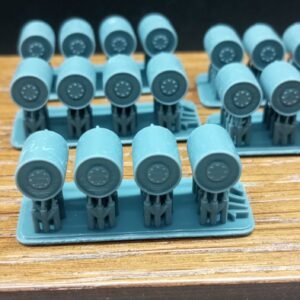
A 1913 Royal Navy Torpedo School report described a device intended for countermining, a “dropping mine”. At Admiral John Jellicoe’s request, the standard Mark II mine was fitted with a hydrostatic pistol (developed in 1914 by Thomas Firth and Sons of Sheffield) preset for 45 ft (14 m) firing, to be launched from a stern platform. Weighing 1,150 lb (520 kg), and effective at 100 ft (30 m), the “cruiser mine” was a potential hazard to the dropping ship. The design work was carried out by Herbert Taylor at the RN Torpedo and Mine School, HMS Vernon. The first effective depth charge, the Type D, became available in January 1916. It was a barrel-like casing containing a high explosive (usually TNT, but amatol was also used when TNT became scarce). There were initially two sizes—Type D, with a 300 lb (140 kg) charge for fast ships, and Type D* with a 120 lb (54 kg) charge for ships too slow to leave the danger area before the more powerful charge detonated.
A hydrostatic pistol actuated by water pressure at a pre-selected depth detonated the charge. Initial depth settings were 40 or 80 ft (12 or 24 m). Because production could not keep up with demand, anti-submarine vessels initially carried only two depth charges, to be released from a chute at the stern of the ship. The first success was the sinking of U-68 off Kerry, Ireland, on 22 March 1916, by the Q-ship Farnborough. Germany became aware of the depth charge following unsuccessful attacks on U-67 on 15 April 1916, and U-69 on 20 April 1916. The only other submarines sunk by depth charge during 1916 were UC-19 and UB-29.
Numbers of depth charges carried per ship increased to four in June 1917, to six in August, and 30-50 by 1918. The weight of charges and racks caused ship instability unless heavy guns and torpedo tubes were removed to compensate. Improved pistols allowed greater depth settings in 50 ft (15 m) increments, from 50 to 200 ft (15 to 61 m). Even slower ships could safely use the Type D at below 100 ft (30 m) and at 10 kn (19 km/h; 12 mph) or more, so the relatively ineffective Type D* was withdrawn. Monthly use of depth charges increased from 100 to 300 per month during 1917 to an average of 1745 per month during the last six months of World War I. The Type D could be detonated as deep as 300 ft (91 m) by that date. By the war’s end, 74,441 depth charges had been issued by the RN, and 16,451 fired, scoring 38 kills in all, and aiding in 140 more.
The United States requested full working drawings of the device in March 1917. Having received them, Commander Fullinwider of the U.S. Bureau of Naval Ordnance and U.S. Navy engineer Minkler made some modifications and then patented it in the U.S. It has been argued that this was done to avoid paying the original inventor.
The Royal Navy Type D depth charge was designated the “Mark VII” in 1939. Initial sinking speed was 7 ft/s (2.1 m/s) with a terminal velocity of 9.9 ft/s (3.0 m/s) at a depth of 250 ft (76 m) if rolled off the stern, or upon water contact from a depth charge thrower. Cast iron weights of 150 lb (68 kg) were attached to the Mark VII at the end of 1940 to increase sinking velocity to 16.8 ft/s (5.1 m/s). New hydrostatic pistols increased the maximum detonation depth to 900 ft (270 m). The Mark VII’s 290 lb (130 kg) amatol charge was estimated to be capable of splitting a 7⁄8 in (22 mm) submarine pressure hull at a distance of 20 ft (6.1 m), and forcing the submarine to surface at twice that. The change of explosive to Torpex (or Minol) at the end of 1942 was estimated to increase those distances to 26 and 52 ft (7.9 and 15.8 m).
The British Mark X depth charge weighed 3,000 lb (1,400 kg) and was launched from the 21 in (530 mm) torpedo tubes of older destroyers to achieve a sinking velocity of 21 ft/s (6.4 m/s). The launching ship needed to clear the area at 11 knots to avoid damage, and the charge was seldom used. Only 32 were actually fired, and they were known to be troublesome.
The teardrop-shaped United States Mark 9 depth charge entered service in the spring of 1943. The charge was 200 lb (91 kg) of Torpex with a sinking speed of 14.4 ft/s (4.4 m/s) and depth settings of up to 600 ft (180 m). Later versions increased depth to 1,000 ft (300 m) and sinking speed to 22.7 ft/s (6.9 m/s) with increased weight and improved streamlining.
Although the explosions of the standard United States 600 lb (270 kg) Mark 4 and Mark 7 depth charge used in World War II were nerve-wracking to the target, a U-boat’s pressure hull would not rupture unless the charge detonated within about 15 ft (4.6 m). Getting the weapon within this range was a matter of luck and quite unlikely as the target took evasive action. Most U-boats sunk by depth charges were destroyed by damage accumulated from an extended barrage rather than by a single charge, and many survived hundreds of depth charges over a period of many hours, such as U-427, which survived 678 depth charges in April 1945.


